
Turning a Rough Sketch Into an OEM Jewelry CAD File
A sketch on paper is a set of intentions; a CAD file is a set of dimensions. The gap between the two is where most launch delays begin. The published benchmark for closing it is under 48 hours for a 3D CAD model, which is 2 days against a sampling window of 25–30 days, or 8% of the shorter window. Two days of modelling is cheap. Two days of misinterpretation is not.

Key takeaways
- CAD is published at under 48 hours, equal to 2 days, against 25–30 days for a physical master.
- The model fixes proportions and stone seats; plating colour and surface texture are decided later, at sample stage.
- A private-label order carries five retail extras, each of which needs artwork before the first carton closes, and an OEM/ODM brief is the right place to list them.
- ISO 9001:2015 applies to every production stage, so the approved model, not the sketch, is the document of record.
What a pencil sketch does and does not say
Most briefs arrive as a drawing with a reference photo beside it. The drawing carries the idea: a curve, a proportion, a stone placed off-centre. It rarely carries the information a mould needs. Wall thickness is unmarked. The inside diameter is implied. The claw height is invisible. The sketch says what the piece should look like from one angle and stays silent about the other five.
A CAD brief closes those gaps in writing. Four numbers do most of the work: the inner diameter or length, the metal thickness at the thinnest point, the stone diameter in millimetres, and the finished weight band the buyer expects. A brief that supplies those four can be modelled without a meeting. A brief that supplies none of them produces a model that looks right in a render and feels wrong on a hand.
Reference images need the same treatment. A photograph of a vintage ring establishes a mood, not a tolerance. The useful instruction is which specific feature to carry across: the taper of the shoulder, the height of the bezel, the spacing between two stones. Everything else in the photograph is context, and copying context is how a design acquires details nobody asked for.
Two days, four decisions
Under 48 hours is a short window, and it works because the decisions inside it are bounded. The modeller decides geometry, thickness, stone seating and the parting line for the mould. Those four choices determine whether the piece can be cast, set and finished at all. They do not determine whether it will be gold, rhodium or gunmetal, because plating happens much later.
Understanding that split prevents a common waste of time. Buyers sometimes hold a CAD review hostage to a plating question. The answer cannot come from the model. Plating colour is proven on a physical sample, under an agreed light source, after the surface has been polished. Holding the file for it simply pushes the 2-day CAD step into the following week.
The same applies to hand-feel. A model can predict weight within a band, but it cannot predict how a clasp sounds or how an edge sits against a wrist. Those judgments belong to the master sample at 25–30 days. The CAD stage should be judged on whether the geometry is buildable, not on whether it is lovable.
Where the model does earn its keep is in repetition. Once a design is approved, the file is the reference for every later size, every reorder and every colourway. A factory operating under ISO 9001:2015 keeps that reference under document control, so a reorder three seasons later starts from the same dimensions rather than from a photograph of a sample.
How to read a CAD review before you sign
Open the file in a viewer that shows dimensions, not just a shaded render. Check the thinnest section first, because that is where casting fails. Then check the stone seats against the actual stone size, allowing for the girdle. Then check the bail or the jump ring, since that is the part most often drawn at a convenient size rather than a functional one.
Ask for a cross-section view at the narrowest point and a weight estimate. A model that reads well from outside can be hollow where it should be solid, or solid where the finished weight would price the design out of its tier. Neither fault is visible in a turntable animation.
Finally, confirm the units. A file drawn in inches and cut in millimetres produces a piece 25.4 times too large, and the error is obvious only after a master is cast. The check takes seconds and has saved entire sampling windows.
The launch pack that ships with the model
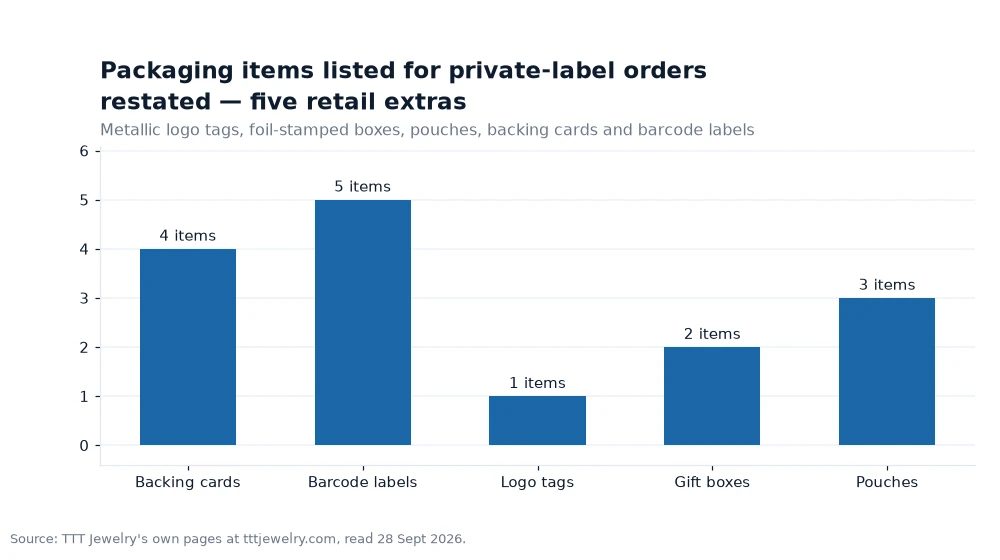
The model is one deliverable among several. A private-label order also needs retail dressing, and the published list runs to five extras: metallic logo tags, foil-stamped gift boxes, velvet or microfibre pouches, display backing cards and barcode labelling. Each one is a print or tooling item in its own right, with its own artwork deadline.
Sequencing them matters because they attach at different points in packing. The tag goes on the piece. The pouch holds the piece and the tag. The backing card holds the pouch or the piece, depending on format. The box closes over the assembly. The barcode label is applied last, because it encodes the variant that the box now contains.
| Retail extra | Function | Late-artwork failure |
|---|---|---|
| Metallic logo tag | Brand mark attached to the piece | Piece packed without identification |
| Foil-stamped gift box | Outer presentation and protection | Cartons held at the packing bench |
| Velvet or microfibre pouch | Storage and travel protection | Loose pieces in bulk bags |
| Display backing card | Shelf hanging and size labelling | Retail fixture cannot be dressed |
| Barcode label | Variant identification at stock intake | Mixed SKUs become indistinguishable |
None of this is jewellery manufacturing in the narrow sense, and that is exactly why it slips. The model is approved, the sample is signed, and then a barcode file is missing three weeks before delivery. Buyers who treat the retail list as part of the brief, not as an afterthought, avoid the last-minute scramble entirely.
Worked example
Take a 50-piece sterling silver run with a five-item retail pack. The CAD step consumes 48 hours, or 2 days. Against a 25-day sampling window that is 48 ÷ 600 = 8%; against a 30-day window it is 48 ÷ 720 = 6.7%. Both figures are small enough that a single avoidable revision, at roughly the same duration, adds about 8% again to the pre-production clock.
Now the retail side. Five extras across 50 units means 250 individual printed or tagged components, assuming one of each per piece. Across a 100-piece brass run the same pack needs 500. That multiplication is the reason artwork deadlines sit earlier than buyers expect: the printing is quick, but the approval, proofing and reprint cycle is not.
Total route for the silver example: 2 days of CAD, 25–30 days of sampling, 21–28 days of bulk. That is 48–60 days, or 6.9–8.6 weeks. The retail pack has to be finalised inside that window, not after it.
Frequently asked questions
How long does it take to turn a sketch into a CAD file?
3D CAD modelling is published at under 48 hours, which is 2 days. That assumes the brief supplies dimensions, stone sizes and a weight band rather than a drawing alone.
Can I change the design after seeing the CAD model?
Yes. Revisions before the master is cut cost hours rather than weeks, which is why the model review is the right moment to settle proportions and stone placement.
Does the CAD file include packaging artwork?
No. Packaging is a separate list of five retail extras, including logo tags, gift boxes, pouches, backing cards and barcode labels, each requiring its own approved artwork.
Where the file stops and the order starts
A CAD file is a plan, and plans need a factory that can read them the same way twice. The published route moves from modelling to a physical master in 25–30 days, which is the point at which a drawing becomes a product with weight and tolerances.
Brands that run the same silhouette in more than one metal often start with a custom brass jewelry sample to test shape and proportion, then move the approved geometry to silver for the main line. The model transfers; the finishing specification does not, because brass needs anti-tarnish e-coating where silver needs its own treatment.
It is worth choosing a sterling silver jewelry manufacturer that keeps the file under version control for exactly this reason. Geometry that survives a metal change is an asset; geometry that lives only in a photograph is a liability.
Source note: figures come from the manufacturer's own website (tttjewelry.com), read 28 Sept 2026.[1]