
A Creator's First Fragrance Order: The Quality Control Walkthrough
A first fragrance order is usually described as a series of creative stages, with quality control treated as something that happens at the end. It does not. Quality control is spread across the whole project, from the wording of the quote to the batch record that arrives after release, and each stage produces something the brand should keep. This walkthrough follows the sequence as a creator-led launch actually experiences it and names the checks that belong at each step.
Key takeaways
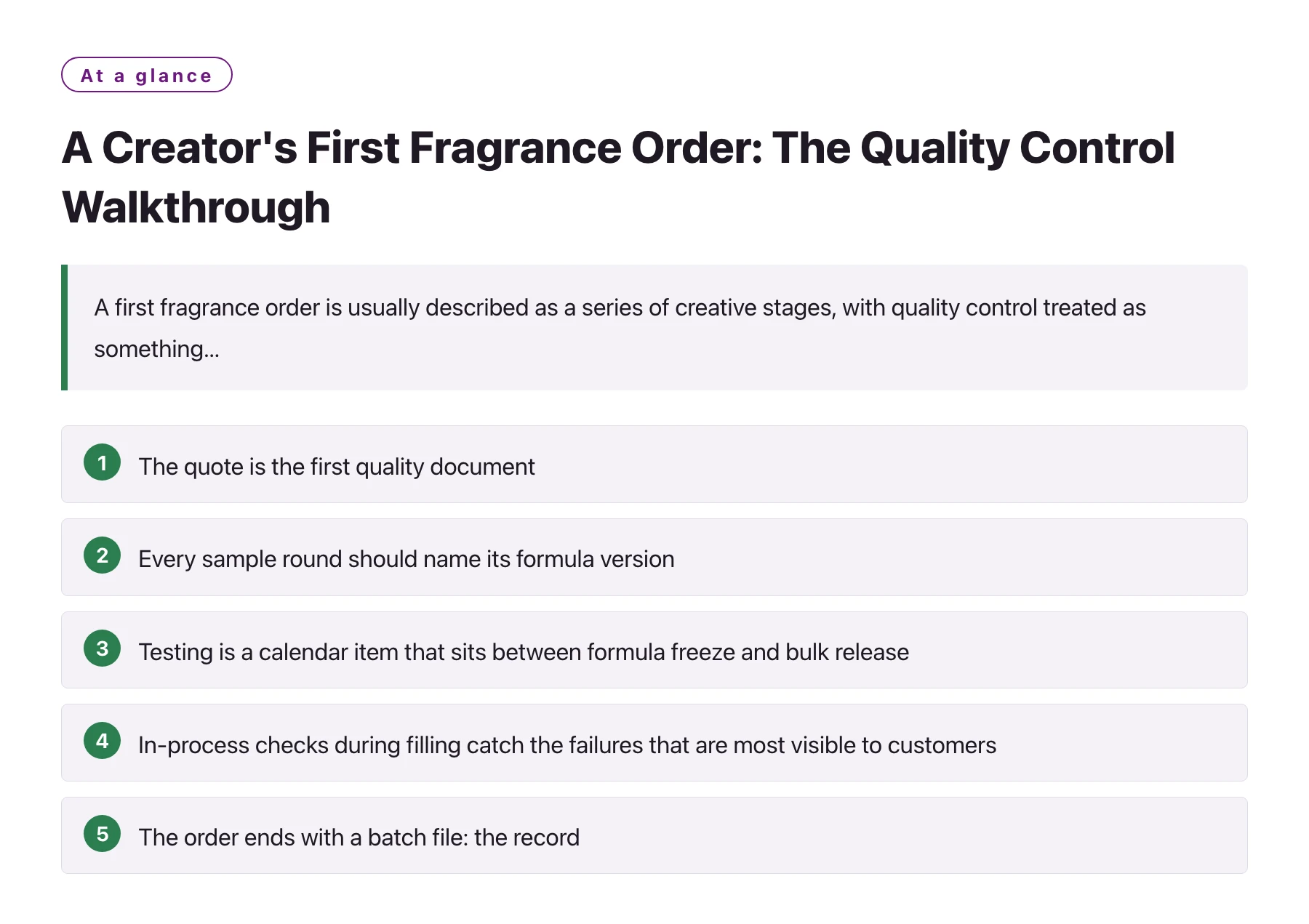
- The quote is the first quality document, because it decides whether testing, retention and documentation are included or treated as extras.
- Every sample round should name its formula version, and the approved version should be frozen in writing at the moment it is signed.
- Testing is a calendar item that sits between formula freeze and bulk release, and the combinations being tested should be named rather than assumed [1].
- In-process checks during filling catch the failures that are most visible to customers, such as fill weight and leaks, before the units are packed.
- The order ends with a batch file: the record, the lot list, the statement of restrictions and allergens, the test reports and the retained reference [2].
For a creator, the first fragrance order often begins with a scent idea and a launch date, and quality control sounds like the supplier's business. That impression lasts until the first problem: a label that does not match the formula, a bottle that leaks in transit, or a question from a follower that the brand cannot answer without emailing the factory.
The sequence below is written to be useful before any of that happens. It follows nine stages and, for each one, names what is being decided, what quality control is doing, and what the brand should keep. Nothing in it requires technical knowledge; it requires knowing what to ask for and when.
Two assumptions are worth stating. The first is a single hero product with one scent, which is the common shape of a creator launch. The second is that the brand is selling in at least one regulated market, which means the documentation in stage four is not optional.
The nine stages, and what to keep from each
- Brief and quoteDecide the format, the volume band and the markets. Check whether the quote includes testing, retention, and the compliance documents. Keep the quote: scope disputes are settled with it.
- Formula directionChoose between a library composition and custom development. Record which one, because it decides who holds the composition later.
- Sample roundsTreat each round as a version with a number. A round that cannot be identified cannot be compared, and a change mid-round creates confusion that costs a week.
- Approved sampleSign the approved version in writing and confirm that a reference is retained from it. From this point, the formula is frozen and testing can begin.
- Compliance fileCollect the ingredient declaration, the restriction and allergen statement, and the safety assessment or its reference. Ask early: these documents drive the label layout.
- Testing windowCompatibility and stability work runs in the actual base and packaging. Name the combinations; published testing scopes are the practical way to check that the work described is work that exists [1].
- Material intake and packaging checkMaterials are checked against their documentation, and decorated components are compared with the approved first-off sample. Ask to see the first-off approval.
- Bulk, fill and packCompounding, filling and packing are recorded as they happen, with checks on fill weight, closure and leaks. This is where a customer-visible defect is either caught or shipped.
- Release and reorderTake delivery of the batch record, the lot list and the retained reference. File them together; the first reorder is where this file proves its worth.
What the brand should actually do at each stage
Most of the work is the supplier's, but three habits make the difference between a smooth first order and a difficult one.
Keep one folder per order and put documents in it as they arrive rather than at the end. The batch record, the label version, the test report and the reference photograph belong together, because the questions that come later rarely arrive one at a time.
Ask for photographs at the stages you cannot attend. A first-off decorated unit, a filled and crimped bottle, and a packed carton are three pictures worth having, and they cost a supplier a minute to take.
Confirm in writing whenever something changes, even slightly. A change agreed on a call is a change that two parties will remember differently, and the whole point of a written scope is that it survives a change of personnel. This matters more with a first order than a repeat one, because neither side has yet learned how the other works, which is why a supplier such as Xuelei Fragrance will usually begin by agreeing the checkpoints rather than the price.
Where a creator launch needs extra care
The audience changes the risk profile in two ways. The first is that a defect is public: a leak photographed by a customer spreads faster than the same defect in a conventional retail line. The second is that questions arrive directly to the brand, which means the brand needs the answers on hand rather than available from the factory in a week.
The practical response is one extra document request at release: a plain-language summary of what was tested and where the documentation is held. It is not a regulatory document and it takes little time to produce, but it turns an awkward question into a confident answer.
Why the compliance file belongs in the middle
Compliance work sits in the middle of the sequence because it depends on the frozen formula and feeds the label. Regulators publish their requirements in different formats, and the European Commission's cosmetics pages are one example of how the specific topics that matter to a product are set out for businesses [3].
The consequence for planning is simple: the market list should be settled before the label is designed. Adding a market after artwork is approved is possible, but it is one of the few changes that regularly moves a launch date.
The two things to keep for the second order
When the first run is released, two items matter more than the rest. The retained reference sample is the physical standard that a reorder is compared against. The batch record is the written account of how the run was made.
Everything else can usually be reconstructed: reports can be reissued, artwork can be re-exported, labels can be reprinted. A reference that was never retained cannot be recreated, which is why retention is worth confirming in writing at the start, long before the bulk run is scheduled.
If the first order has to be simple, simplify it this way: one scent, one format, one market, a library or custom composition chosen deliberately, and three documents requested in writing before the label is designed. That is a small project with a complete paper trail, and it is far easier to repeat than a complicated one with gaps. Working with a partner on one-stop fragrance manufacturing reduces the number of handovers in this sequence, and asking how a single partner from formula to finished bottle is managed in practice is a fair way to test whether a supplier really runs the whole path or merely coordinates it.
Sources
- SGS: Cosmetics, Personal Care & Household Testing —— Testing, inspection and certification services for cosmetics and personal care, including microbiological, stability and safety testing aligned with cosmetics GMP.
- Cosmetics & Toiletries —— A technical magazine for cosmetic formulators, covering ingredients, formulation science and testing methods.
- European Commission: Cosmetic Products — Specific Topics —— EU pages covering specific cosmetics topics such as product claims, nanomaterials and animal-testing rules.
Frequently asked questions
What documents should arrive with the first finished order?
At minimum: the batch record for the run, a lot traceability list, the restriction and allergen statement for the version produced, any test reports commissioned during development, and confirmation that a retained reference is held. A brand should ask for the list before the order is placed rather than after release.
How involved does a creator need to be during production?
Not very, provided three things are agreed in advance: the approved sample, the label version and the release criteria. Photographs at the decoration and filling stages cover most of what an on-site presence would. The exception is a decoration run with a new technique, where a first-off approval is worth waiting for.
Can the first order skip stability testing to save time?
It is possible to run a reduced programme and accept more risk, but the decision should be explicit rather than accidental. Testing is often the only stage that reveals a compatibility problem with the packaging, and finding that problem after a launch is considerably more expensive than the testing was.
What is the most common first-order mistake?
Approving the label before the formula is frozen. The ingredient declaration depends on the formula version, so a late formula change reopens the artwork, and artwork changes are the ones most likely to move a print slot and a launch date.
How soon should the second order be planned?
Before the first sells out. Reorders involve the same materials, packaging and scheduling steps, and the retained reference is the only thing that makes the comparison straightforward. Brands that keep the reference and the batch file together usually find the second run uneventful.
Operations software that compounds.
Replace six disconnected ops tools with one auditable system of record. See how teams at Vercel, Mercury, Linear, and Ramp run their recurring workflows on OpoSoft.